
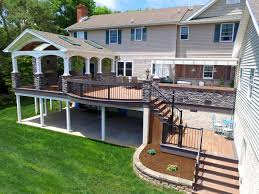
Houston-area soil is predominantly clay — the residential code’s own bearing-value table ranks it the weakest soil class on the chart. Here is what that means for how a deck or patio cover’s footings actually get sized, and what the code requires when soil tests as truly expansive.
Book a Deck ConsultationCall (832) 532-6829
Source: IRC 2021 (Texas-adopted) Tables R401.4.1 and §R403.1.8.1, via up.codes’ Texas viewer (icc-safe.org blocked automated access — see Sources). Checked Oct. 7, 2026. The same shrink-swell cycle is why a patio surface right next to the house also needs to shed water away from the foundation — see MAV’s guide to patio drainage and grading requirements near a Houston foundation.
Why Houston soil changes the footing math
The residential code sizes a deck footing from two numbers: how much load it actually carries (its tributary area) and how much the soil underneath can bear. Houston-area clay sits at the bottom of the code’s own bearing-value table — 1,500 psf — so a footing that would be small on sandy or gravelly ground often has to be larger here to carry the identical deck.
IRC Table R401.4.1 lists five presumptive load-bearing classes, from crystalline bedrock at 12,000 psf down to clay, sandy clay, silty clay, clayey silt and sandy silt clay at 1,500 psf — the lowest class on the table. Much of the Houston area sits on exactly that bottom class. The table does not leave the number to a guess, either: if the building official determines the actual in-place soil is likely to bear less than 1,500 psf, a soils investigation has to establish the real figure before footings are designed.
| Soil class | Presumptive bearing value |
|---|---|
| Crystalline bedrock | 12,000 psf |
| Sedimentary and foliated rock | 4,000 psf |
| Sandy gravel and/or gravel (GW, GP) | 3,000 psf |
| Sand, silty sand, clayey sand, silty gravel, clayey gravel (SW, SP, SM, SC, GM, GC) | 2,000 psf |
| Clay, sandy clay, silty clay, clayey silt, silt, sandy silt clay (CL, ML, MH, CH) | 1,500 psf |
Same deck, different footing by soil class
+View as table
| Item | Value (in) |
|---|---|
| Clay soil — 1,500 psf | 10 |
| Sandy gravel — 3,000 psf | 7 |
Source: IRC 2021 (Texas-adopted) Table R507.3.1 worked example, via up.codes. Checked Oct. 7, 2026.
The same comparison holds at a larger 80 sq ft tributary area: the code’s own example works out to roughly a 20 in square footing on 1,500-psf clay versus about 14 in on 3,000-psf gravelly soil. The pattern is consistent — weaker soil needs more footing footprint to carry the same load, which is exactly why a soil-bearing assumption matters before footings get poured, not after.
Pick what’s closest to your project:
This helper summarizes the IRC/IBC provisions cited in this guide; it is not a soils report or structural assessment of your specific lot. A contractor confirms actual conditions before finalizing a footing design.
When soil tests as truly expansive
IRC §R403.1.8.1 defines when a soil crosses from merely “clay” into the code’s formal “expansive soil” category — triggered by a Plasticity Index of 15 or greater, more than 10% of particles passing a No. 200 sieve, more than 10% smaller than 5 micrometers, or an Expansion Index over 20. Once that classification applies, §R403.1.8 sends the foundation design to IBC §1808.6.
How a footing design actually comes together
- 1ConfirmEstablish the soil-bearing assumptionA contractor starts from the presumptive bearing value for the soil type present (clay defaults to 1,500 psf under Table R401.4.1), unless the permitting jurisdiction requires an actual soils investigation first.
- 2SizeSize each footing to its tributary areaTable R507.3.1 keys footing dimensions to how much load each footing actually carries — a low deck’s footing and an elevated deck’s footing of the same footprint are not sized the same way.
- 3ClassifyRule expansive soil in or outIf visible signs (cracking, uneven hardscape, known regional clay) or a soils test point to IRC §R403.1.8.1’s expansive-soil criteria, the design routes to IBC §1808.6 instead of a standard presumptive-bearing footing.
- 4Form & pourForm, reinforce and pour to the sized dimensionsFootings are formed and poured to the depth and footprint the governing table and/or engineered design call for — not a generic one-size assumption.
- 5InspectInspect before it’s coveredLike any foundation element, footing depth and bearing are typically confirmed by inspection while the excavation is open — once backfilled, they can’t be checked again.
Tick each one off as your contractor answers it.
Based on the IRC/IBC provisions cited in this guide. Not a substitute for a soils report or a licensed engineer’s review on a specific lot.
Verified Google reviews from MAV patio-cover clients — MAV’s closest related Outdoor Living service to deck construction; no deck-specific review exists in the verified set yet.
“Really happy with the patio cover! The quality is great, it looks amazing, and it gives perfect shade.”
“I love my new patio cover!! It’s a great, very professional company, they did everything from A to Z.”
“Amzing patio cover , service was very professional!!!”
“Thank you for the patio cover in the outdoor kitchen in my yard its great”
About MAV Design & Build
Frequently asked questions
Does Houston soil count as "expansive" for deck footing design?+
Why does a bigger footing matter on clay?+
What if the soil tests as truly "expansive," not just clay?+
Does a low deck need the same footing design as an elevated deck?+
Can a deck footing ever skip a concrete footing entirely?+
Who decides if a soils investigation is needed before pouring footings?+
Planning a deck or patio cover in Houston?
Tell MAV about the site and we will confirm what the soil underneath actually needs — a standard presumptive-bearing footing, or an engineered design — before footings ever get poured.
Book a Deck ConsultationCall (832) 532-6829For deck styles and materials, see MAV’s deck construction hub and the deck materials guide for the Houston climate. For patio covers, see MAV’s patios service line.For a side-by-side look at MAV’s own published deck and patio cost ranges, see MAV’s deck & patio installation cost guide. If your property is in a deed-restricted community, also confirm whether your deck or patio cover needs architectural review before you build — see MAV’s guide to HOA architectural review for a pergola, deck or patio cover in Texas. For a poured concrete patio build specifically, see MAV’s concrete patio page.
- IRC 2021 (Texas-adopted), §R507.3 — Deck Footings — up.codes Texas viewer (icc-safe.org’s own hosted text blocked automated access; corroborated via up.codes)
- IRC 2021 (Texas-adopted), Table R507.3.1 — Deck Footing Size
- IRC 2021 (Texas-adopted), Table R401.4.1 — Presumptive Load-Bearing Values
- IRC 2021 (Texas-adopted), §R403.1.8 / §R403.1.8.1 — Foundations on Expansive Soils
- IBC 2021 (Texas-adopted), §1808.6 — Design Options for Expansive Soils
- MAV Design & Build: Deck Construction
- MAV Design & Build: Best Deck Materials for the Houston Climate
icc-safe.org (the ICC’s own code-hosting site) and houstonpermittingcenter.org both returned blocked/403 responses to automated fetches during this research, consistent with prior MAV articles’ findings; all IRC/IBC figures above were corroborated via up.codes’ Texas-adopted viewer and disclosed in full in research.md, never presented as a direct primary-site read. Houston’s 2024-01-01 IRC-2021-with-amendments adoption date is reused from prior, separately verified MAV research (see research.md) rather than re-derived here. Checked October 7, 2026.
I'm extremely satisfied with my kitchen renovation. The entire process was handled with professionalism and precision. The crew was respectful, efficient, and always made sure I was informed every step of the way. The final result — a beautiful, well-designed kitchen with top-quality finishes and excellent craftsmanship.
Love their work, the kitchen turned out amazing and exceeded our expectations. Completed in much shorter time than I thought it would. Can't recommend them enough!!
Great experience working with this company! They remodeled my kitchen and did an amazing job. The team was professional, easy to work with, and always on time. Everything went smoothly, and they paid attention to the small details.