
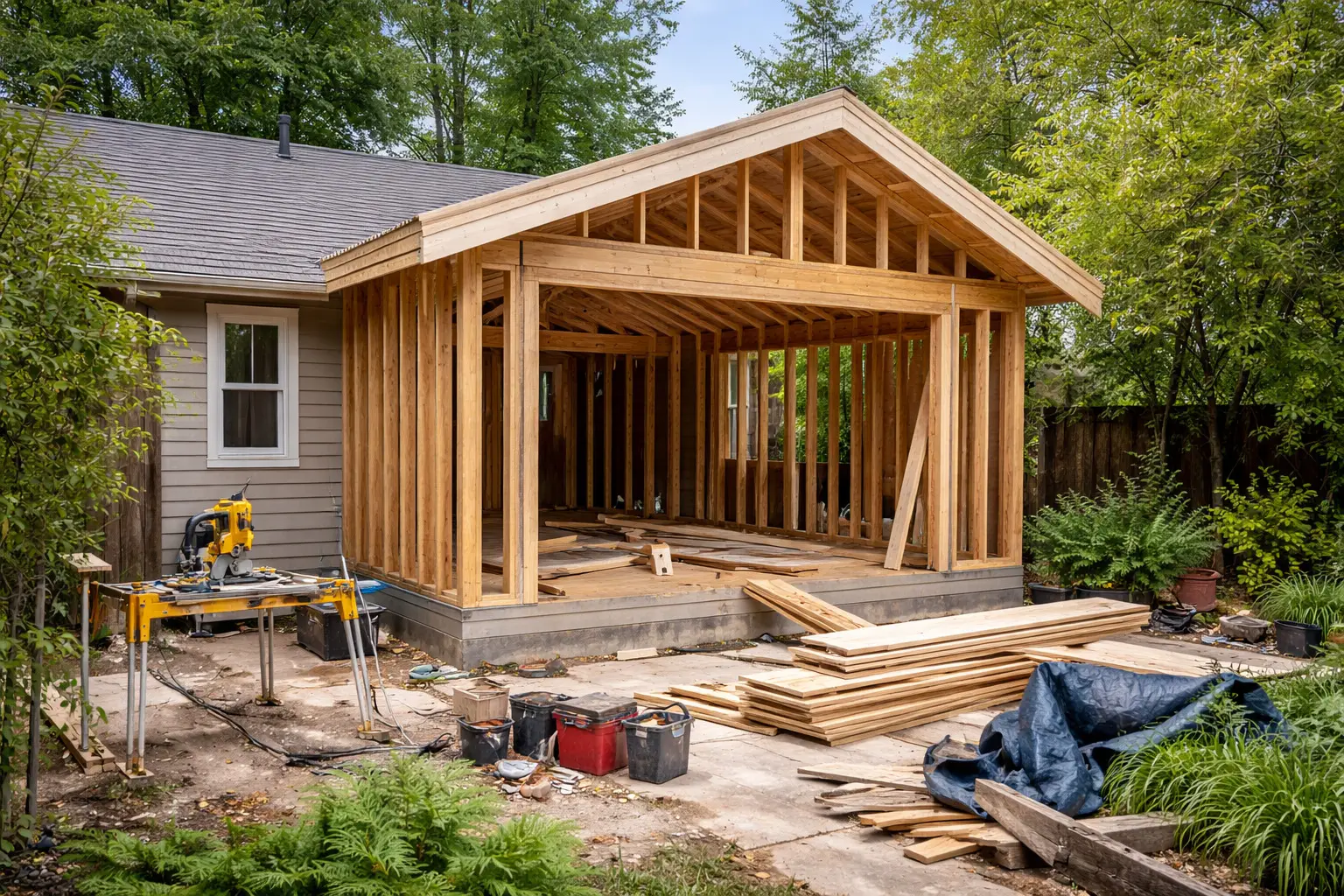
The real question isn’t whether converting a garage is “covered” — it’s which part of your policy it falls under, and that depends on whether your garage is attached or detached.
Book a Garage Conversion ConsultationCall (832) 532-6829Source: Texas Department of Insurance, “Home insurance: What structures are covered?” and Home Insurance Guide, both read in full Nov 8, 2026.
Attached or detached changes the answer
A quick answer: an attached garage is already inside your dwelling coverage. A detached garage is covered separately, as “other structures,” and that part of your policy is usually capped.
The Texas Department of Insurance’s own consumer guide defines the coverage part plainly: “Other structures coverage pays to repair structures on your property that aren’t attached to your house. This includes detached garages, storage sheds, and fences.” That single word — attached — is what separates the two situations. An attached garage was never “other structures” to begin with; it was already part of the dwelling TDI and your carrier are valuing today.
Why the cap matters once you convert
TDI’s own tips page states it directly: “Most home policies include coverage for other structures at 10% of your house’s insured value.” That 10% is sized for a shed, a fence, or a garage used for parking and storage — not for a finished bedroom, home office, or a garage apartment with its own kitchen and bath. Converting a detached garage into real living space moves genuine value into a coverage bucket that was never meant to carry it.
+View as table
| Item | Value (%) |
|---|---|
| Other-structures coverage, typical cap (share of dwelling value) | 10 |
| Dwelling coverage, minimum required (share of replacement cost) | 80 |
Source: Two separate requirements, not alternatives — both published directly by TDI. Source: TDI, “Home insurance: What structures are covered?” and TDI, Home Insurance Guide, both read in full Nov 8, 2026.
Which starting point describes your garage?
Pick the option that matches your project:
This helper summarizes how TDI’s own published coverage definitions apply to each situation. It is general information, not insurance advice — confirm your own policy’s terms and limits with your agent or carrier.
Before you start the build
- 1AskCall your agent before signing a construction contractDescribe the project — attached or detached, square footage, whether it becomes a rentable second dwelling unit — and ask directly whether it changes which coverage part applies.
- 2AskAsk about course-of-construction coverageSome policies or contractor agreements address coverage gaps during the build itself. Confirm what’s covered while work is in progress, not just after completion.
- 3KeepKeep permit and contractor recordsPermits, final inspections and contractor invoices document the new square footage and systems — useful if a future claim ever needs to establish what changed and when.
- 4RecheckRe-confirm your dwelling coverage amount once it’s finishedWith the added finished space and systems, check that your dwelling coverage still meets the 80%-of-replacement-cost minimum most Texas carriers require.
Verified Google reviews from MAV’s projects across our services.
“I had a great experience with Mav building my ADU. The entire process was smooth, professional, and much easier than I expected. Their team was responsive, transparent, and kept me informed every step of the way.”
“Just completed my ADU with MAV great experience from start to finish highly recommend working with shon very professional”
“MAV Design & Build did an excellent job with our remodeling project. The team was professional, responsive, and paid close attention to the details.”
About MAV Design & Build
Frequently asked questions
Does converting an attached garage change which part of my homeowners policy covers it?+
What about a detached garage — does that work differently?+
Do I have to carry builder’s-risk or course-of-construction coverage during the conversion?+
How much of my home does Texas require me to insure?+
Is this the same question as whether a garage conversion raises my property taxes?+
What does MAV handle on the insurance side of a garage conversion?+
Planning a garage conversion?
Scope the build right the first time — and give your insurance agent the same clear picture of the finished space that your contractor is working from.
Book a Garage Conversion ConsultationCall (832) 532-6829For the full garage-conversion overview, see MAV’s garage conversions hub. For typical project cost ranges, see the garage conversion cost guide. For converting a garage into a full ADU, see garage conversion to ADU. For the separate question of property-tax reassessment, see will a home addition raise your property taxes. If the conversion itself was done without a permit, see MAV’s guide to unpermitted garage conversion disclosure & risk.
- Texas Department of Insurance: Home insurance guide (cb025.html)
- Texas Department of Insurance: "Home insurance: What structures are covered?"
- MAV Design & Build: Will a Home Addition Raise Your Property Taxes in Texas?
Both Texas Department of Insurance pages were fetched directly from tdi.texas.gov and read in full on November 8, 2026; the quotes above are verbatim. This page describes general coverage concepts published by TDI and is not insurance advice — homeowners should confirm their own policy’s terms, limits and any course-of-construction coverage with their own agent or carrier. No specific builder’s-risk rule is stated because none was found on tdi.texas.gov this run.
I'm extremely satisfied with my kitchen renovation. The entire process was handled with professionalism and precision. The crew was respectful, efficient, and always made sure I was informed every step of the way. The final result — a beautiful, well-designed kitchen with top-quality finishes and excellent craftsmanship.
Love their work, the kitchen turned out amazing and exceeded our expectations. Completed in much shorter time than I thought it would. Can't recommend them enough!!
Great experience working with this company! They remodeled my kitchen and did an amazing job. The team was professional, easy to work with, and always on time. Everything went smoothly, and they paid attention to the small details.