Kitchen Countertop Materials Compared for Houston Kitchens
Quartz, granite, quartzite, marble, porcelain, soapstone, butcher block, solid surface, laminate, and concrete all trade off heat tolerance, stain and etch resistance, and upkeep differently. Here’s what each one actually is, how it holds up in daily use, and where it fits a Houston kitchen remodel.
Illustration. Five countertop material swatches — quartz, granite, quartzite, marble, and porcelain — shown side by side to represent the comparison on this page.
0.40% max
Water absorption allowed for granite, ASTM C615 — lower means less porous
0.20% max
Water absorption allowed for marble, ASTM C503
≤ 0.5%
Water absorption that classifies a tile as porcelain, ANSI A137.1
Which countertop material is right for a Houston kitchen?
There’s no single best countertop material — the right one depends on how the kitchen actually gets used. Engineered quartz and porcelain resist stains and never need sealing; natural granite and quartzite are heat-tolerant and durable but benefit from periodic sealing; marble is prized for its look but etches with acid; butcher block and solid surface are repairable but need more routine care than the others.
Which direction fits your kitchen?
Interactive check
Find your starting point
Pick what matters most to you day to day:
Look at engineered quartz or a porcelain slab. Both are manufactured to be extremely low-porosity, so neither is typically sealed the way natural stone is — see the quartz and porcelain sections below for how their heat-handling differs.
Granite, quartzite, marble, and soapstone are all natural stone, each cut from the earth, so no two slabs are identical. Granite and quartzite are the most heat- and scratch-tolerant of the four; marble and soapstone need more careful daily handling.
Butcher block brings real wood warmth to an island or prep surface, but it has to be oiled on a regular schedule and kept away from standing water and direct heat — see the butcher block card below for manufacturer guidance.
Laminate remains the most budget-friendly option and has improved in appearance, but it has the tightest heat limits of any material on this page — a hot pan set directly on it can cause lasting, unrepairable damage.
This helper is a starting point, not a specification — a kitchen designer should confirm the right material against your layout, budget, and how the kitchen is used.
Natural, quarried stone
Cut from the earth — no two slabs are identical, and most benefit from periodic sealing.
Granite
Natural igneous stone. One of the most heat- and scratch-tolerant natural materials, with a maximum water absorption of 0.40% under ASTM C615. Benefits from periodic sealing to stay stain-resistant.
Quartzite
A natural metamorphic rock — sandstone that heat and pressure converted into a quartz-rich stone, per the Natural Stone Institute. True quartzite is hard and heat-tolerant (max 1% absorption, ASTM C616). Stone marketed as “soft quartzite” is most often actually marble, not true quartzite.
Marble
Natural metamorphic stone composed mainly of calcite, with a max absorption of 0.20% (ASTM C503). Calcite etches on contact with acid — lemon juice, vinegar, and wine can leave a dull mark on a polished surface.
Soapstone
Natural metamorphic, talc-based stone. Vermont Soapstone notes it “never stains because it is non-porous,” and is “soft enough to shape using simple woodworkers tools” — the same softness that makes it repairable also means it scratches and dents more easily than granite.
Engineered & fired surfaces
Manufactured, not quarried — built for very low porosity and no sealing.
Quartz (engineered stone)
Crushed natural quartz bound with a polymer resin. Non-porous and stain-resistant with no sealing needed, but Cambria is explicit that it “is not heat-proof” — the resin binder, not the mineral, is the weak point near direct heat.
Porcelain slab
Clay and mineral slabs fired at high temperature into a dense surface. A tile or slab is only classed as porcelain once it meets a water absorption of 0.5% or less (ANSI A137.1); the large-format panels used for countertops meet the separate ANSI A137.3 standard. Very heat- and stain-resistant, and never sealed.
Solid surface
An acrylic/polyester blend (e.g. Corian). DuPont’s own care guide calls it heat resistant but gives no specific temperature limit — it simply says never place a hot pot or pan directly on the surface, a trivet is always required. Fine scratches and small cuts are sandable and repairable, a trait few other materials on this page share.
Not the same as porcelain: sintered “ultracompact” surfaces (e.g. Dekton) are a separate product category. Cosentino’s own brochure describes Dekton as a blend of the raw materials used in glass, porcelain, and quartz surfacing, fused with its own Sinterized Particle Technology — a different manufacturing process from both fired porcelain and resin-bound quartz, so the three shouldn’t be treated as interchangeable when comparing heat or scratch behavior.
A note on fabrication-shop safety: cutting and polishing engineered quartz releases crystalline silica dust, and some engineered-stone products are made of up to 95% crystalline silica. This is a hazard for the fabrication-shop workers who cut and polish slabs, not for a finished, installed countertop in a home — CDC/NIOSH and OSHA jointly publish dust-control guidance for fabrication shops.
Wood, laminate & poured surfaces
Butcher block
Solid wood. John Boos recommends oiling it on a regular schedule so the oil “penetrates deep into the grains of the wood to protect and revitalize the wood fibers.” Heat-limited and needs to stay away from standing water.
Laminate
Layered paper and resin over particleboard. The most heat-limited material here — Formica’s own care guide allows roughly 275°F briefly, but prolonged exposure to 140°F or higher can separate the laminate from its core.
Concrete
Poured and cast in place or off-site. Concrete Network notes it has a “naturally porous surface” that needs sealing to resist stains, and that minor shrinkage cracks can develop but are “usually not structural.”
Heat-resistant is not the same as heatproof
Every manufacturer cited on this page draws the same line: a material can resist moderate, brief heat without being damaged by direct, sustained contact with a hot pan. Quartz, solid surface, and laminate all specifically warn against skipping a trivet; natural stone and porcelain tolerate direct heat better, but every material’s own installer or manufacturer still recommends a trivet near edges and seams, where sudden temperature change is most likely to cause a crack or mark.
Illustration. A hot pan on a trivet keeps heat off the countertop slab; a hot pan placed directly on the surface risks a heat mark, particularly on resin-, wood-, or laminate-based materials.
Maximum water absorption allowed by material standard+View as table
An edge profile is mostly a style and safety choice, not a material question — eased, bullnose, and mitered (waterfall) edges all work on most sealed natural stone or engineered slabs, though a dramatic waterfall edge uses significantly more material and requires precise mitered seams at the corner.
Illustration. Three countertop edge profiles: a slightly rounded eased edge, a fully rounded bullnose edge, and a mitered waterfall edge that continues vertically down to the floor.
Pairing a waterfall-edge island in one material with a different material on the perimeter counters is a common way to add contrast without covering every surface in the most expensive slab in the kitchen. The main requirement is that each material is templated and fabricated to meet cleanly wherever the two surfaces transition — it is a layout and budget decision, not a structural one.
A countertop can usually be removed and replaced without damaging the cabinet boxes underneath it, provided the sink and cooktop are disconnected first and the old top is lifted — not pried — free from underneath. The cabinet material, how the original top was attached, and whether the sink is undermounted all affect how straightforward this is, so a good practice is having the existing cabinets assessed before a new material is ordered.
Questions to ask before choosing a new kitchen countertop
Tick each one off as your contractor answers it.
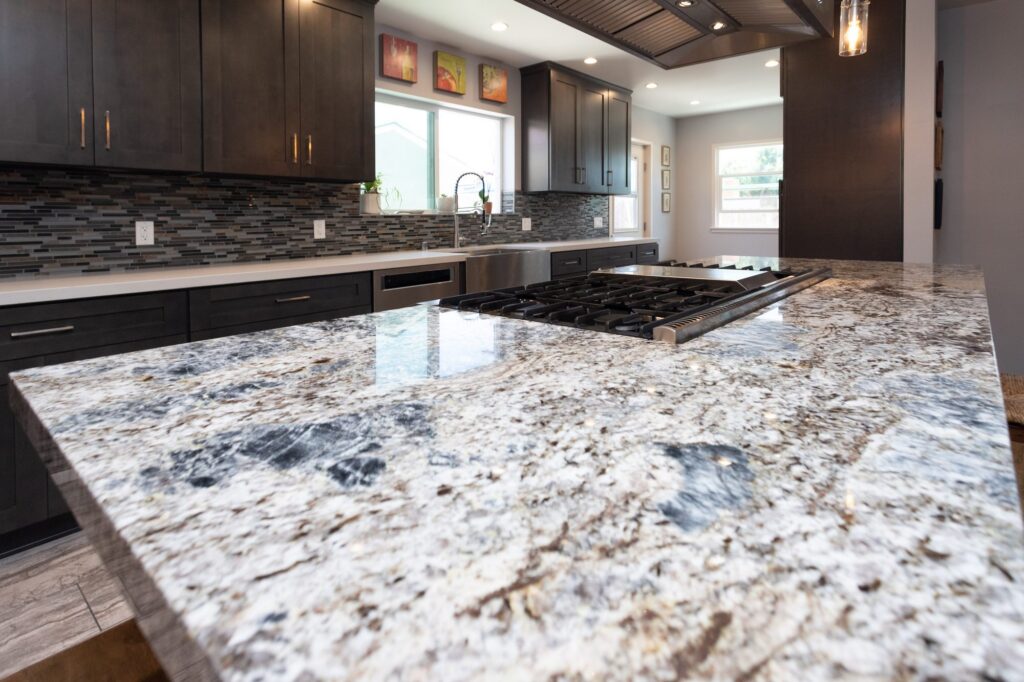
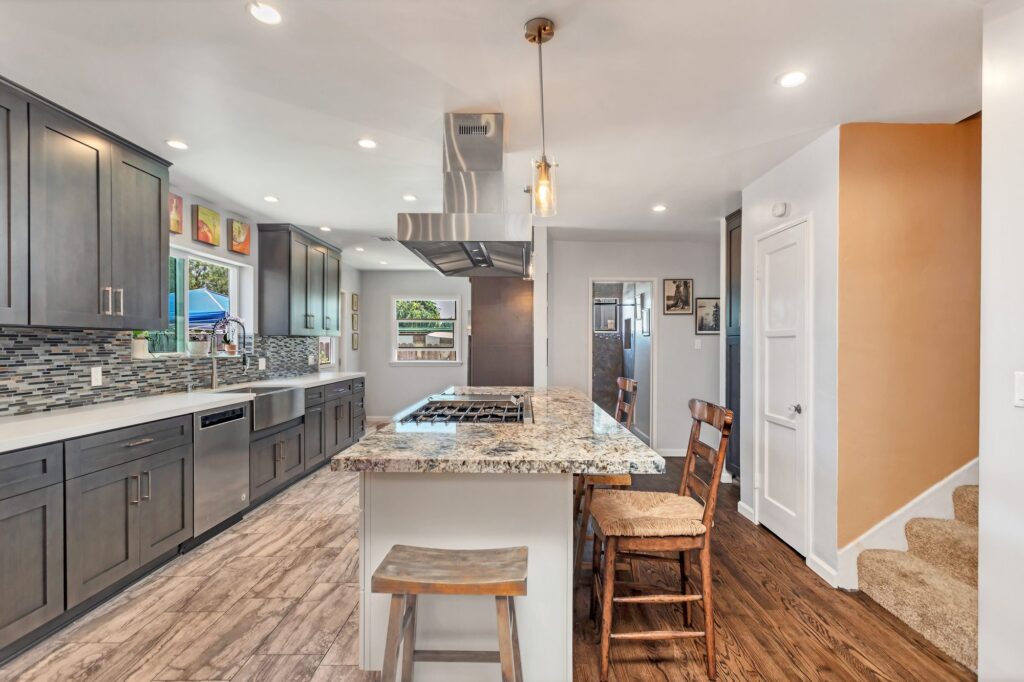
MAV kitchen project — granite-look waterfall island
A completed MAV kitchen project; location not published. The waterfall-edge island reads as a different, darker-veined stone from the lighter perimeter countertop around the sink — a common way homeowners mix materials between an island and the perimeter.
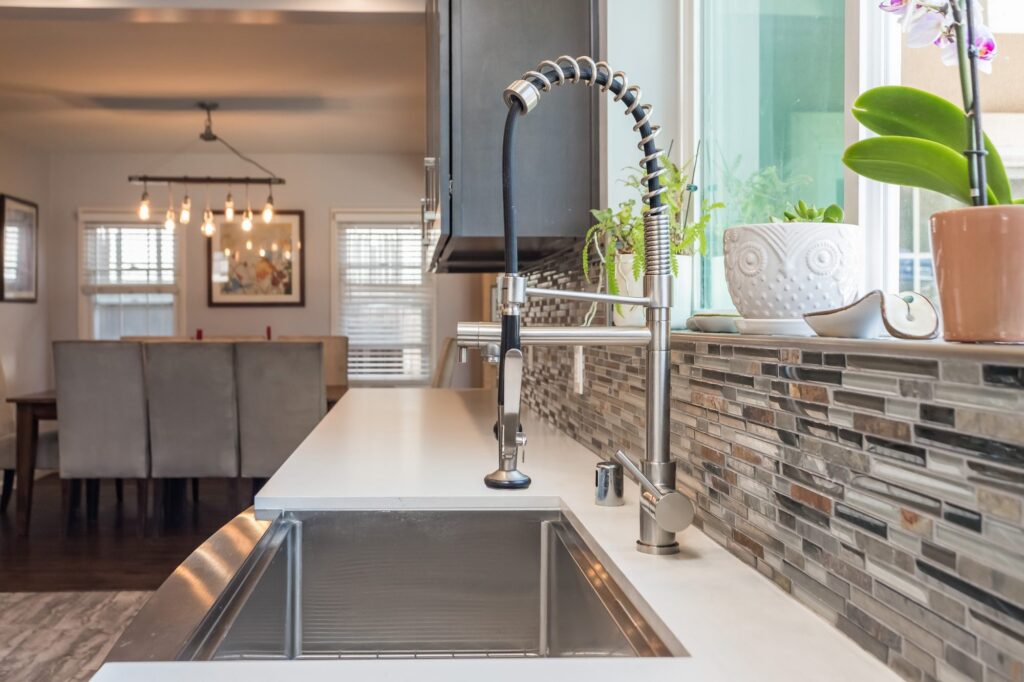
The island’s waterfall edge and dramatic veining, with a built-in gas cooktop.The lighter perimeter countertop around the farmhouse sink, a different material from the island.A wide view of the kitchen showing both the island and the perimeter counters together.
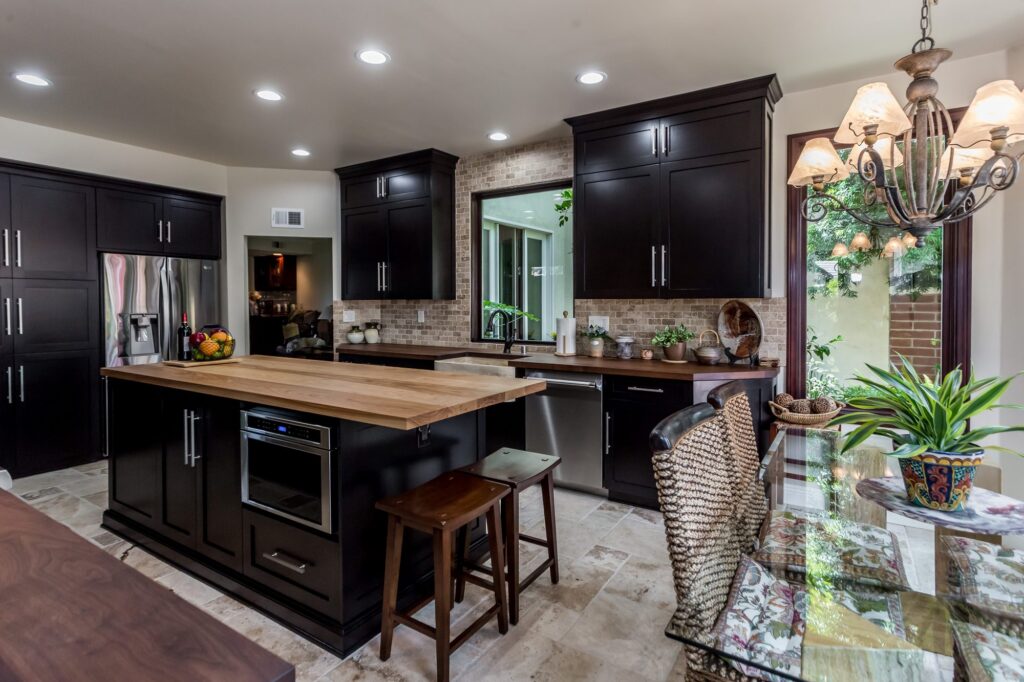
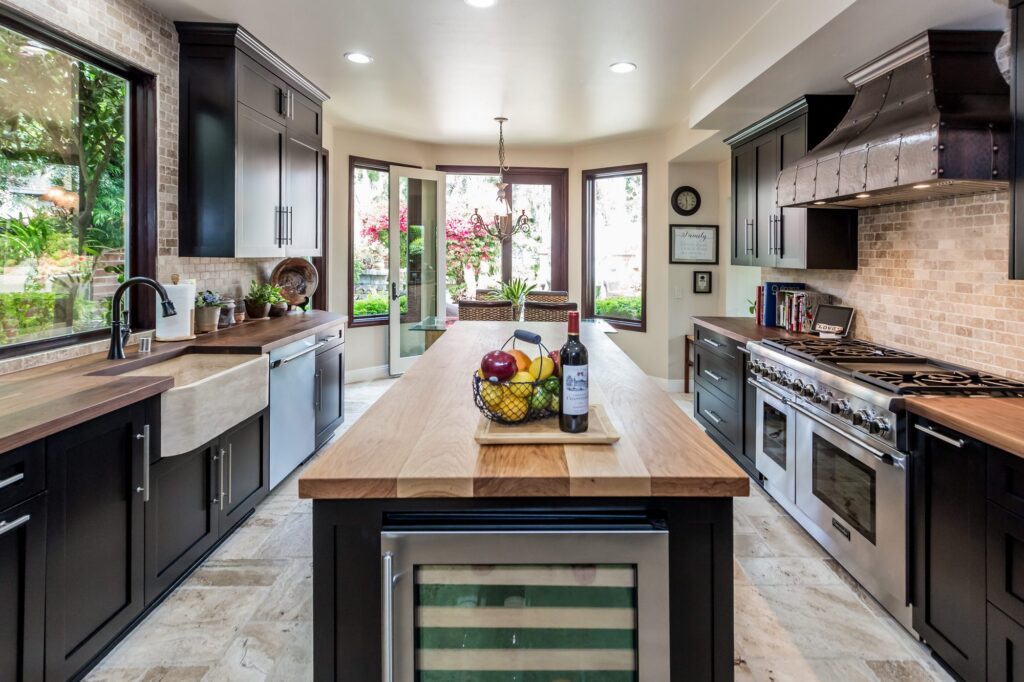
MAV kitchen project — butcher block island
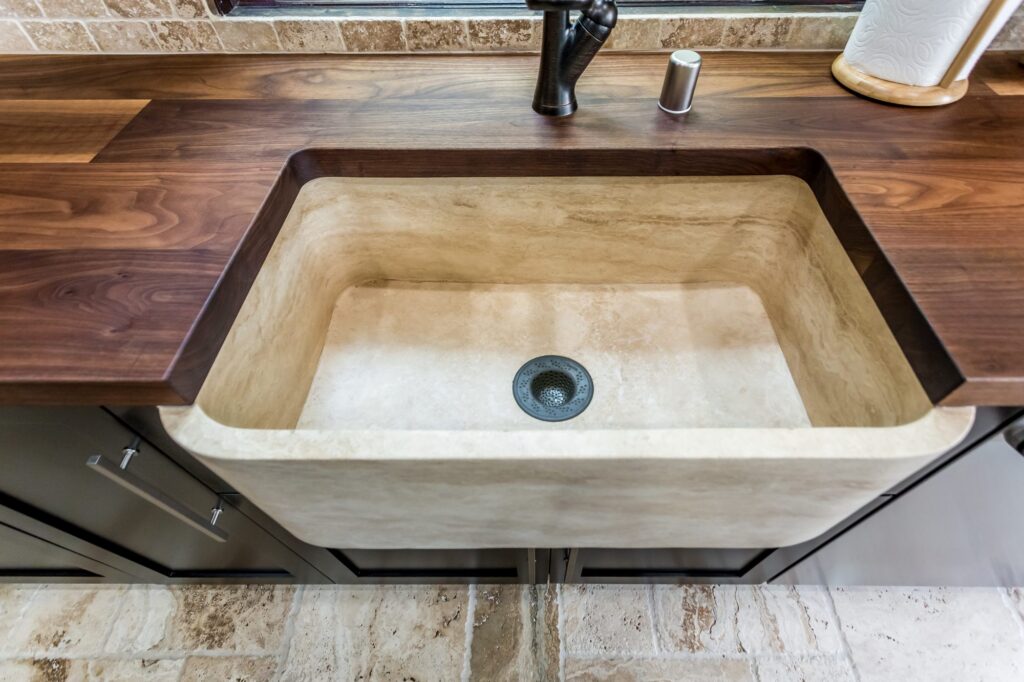
A completed MAV kitchen project; location not published. The island’s butcher block top pairs real wood warmth with espresso cabinetry and a stone farmhouse sink.
Espresso shaker cabinetry pairs with the butcher block island, with an adjoining breakfast nook.The full run of butcher block counters alongside the stainless range.A stone farmhouse-style sink set directly into the butcher block countertop.
Templating & installation timing
1
First
Cabinets are set and leveled
Base cabinets go in and are leveled before a fabricator can template — the countertop depends on the cabinets being in their final position.
2
Template
Precise measurement of the installed cabinets
A template is taken directly off the installed cabinets, not the original drawings, capturing sink and cooktop cutout locations before the slab is cut.
3
Fabrication
Cutting, edging, and polishing
The fabricator cuts, edges, and polishes the material off-site while the rest of the remodel continues around it.
4
Install
Set, seamed, and reconnected
The finished countertop is set onto the cabinets, any seams are finished, the sink and cooktop are reconnected, and a sealant is applied where the material calls for it.
What MAV kitchen-remodel clients say on Google5.0on Google
Verified Google reviews from MAV Design & Build kitchen remodeling clients.
“Really happy with the kitchen remodel by MAV Design & Build! They did a great job with the cabinets, countertops, backsplash, lighting, and overall layout.”
“I recently had my kitchen remodeled by this company, and I’m extremely happy with how everything turned out. The cabinets, countertops, and finishes all came together perfectly.”
“I’m extremely satisfied with my kitchen renovation. The entire process was handled with professionalism and precision.”
Which countertop material is best for my kitchen?+
There isn’t one best material — it depends on priorities. If avoiding sealing matters most, engineered quartz or a porcelain slab are the lowest-maintenance options. If the natural-stone look matters most, granite and quartzite handle daily wear better than marble or soapstone. Budget, the look you want, and how much routine care you’re willing to give the surface should all weigh into the choice.
Can I replace countertops without damaging the cabinets?+
In most cases, yes — a careful installer disconnects the sink and cooktop, removes the old top without prying against the cabinet boxes, and sets the new material on the same base cabinets. Whether that’s realistic for a given kitchen depends on the cabinet material and how the original top was attached, which is why it’s worth having the cabinets assessed before the new material is ordered.
Can I mix countertop materials?+
Yes. Using one material on an island — often with a waterfall edge — and a different material on the perimeter counters is a common way to add contrast and manage cost. The main requirement is that each material is properly templated and fabricated so the two surfaces meet cleanly wherever they transition.
When are countertops measured and installed?+
Countertops are templated after the base cabinets are installed and leveled, since the template has to match the cabinets’ actual final position rather than the original drawings. The slab is then fabricated off-site while other remodel work continues, and it’s set, seamed, and connected to the sink and cooktop once it’s ready.
Are butcher block countertops practical?+
They can be, with a maintenance habit behind them: butcher block manufacturers such as John Boos recommend oiling the wood on a regular schedule to protect the wood fibers from water and everyday wear. Many homeowners use butcher block on an island or a baking zone and pair it with a lower-maintenance material around the sink and range.
Is marble too high maintenance for a family kitchen?+
Marble is calcite, and calcite etches on contact with acidic foods and drinks — lemon juice, vinegar, wine, and tomato sauce can all leave a dull mark on a polished surface, often (Connecticut Stone). That doesn’t rule marble out, but it’s a real daily-use tradeoff, and some homeowners who love the look use it on a backsplash or an accent area instead of the full working countertop.
Are porcelain countertops a good choice?+
Porcelain is fired at high temperature into a very low-porosity surface — a tile only qualifies as porcelain once it tests 0.5% or less water absorption (ANSI A137.1), and the large-format panels used for countertops meet the separate ANSI A137.3 standard. That low porosity makes it stain-resistant and sealing-free. It’s also heat- and scratch-resistant, though like any slab material it can chip at an unsupported edge under a sharp impact.
How do I coordinate cabinets, countertops, flooring, and hardware?+
Start with whichever material is hardest to change later — usually the flooring or the cabinets — and build outward from there, choosing a countertop and hardware finish that read as intentional with both. This kind of combination is normally worked out on paper or in a 3D rendering before anything is ordered, which MAV can plan as part of a kitchen remodel.
Choosing a countertop material?
MAV can help you weigh material tradeoffs — heat, stains, upkeep, and cost — as part of a full kitchen remodel, from quartz and granite to butcher block and porcelain.
Stone and waterfall tops from completed projects. Locations are not published.
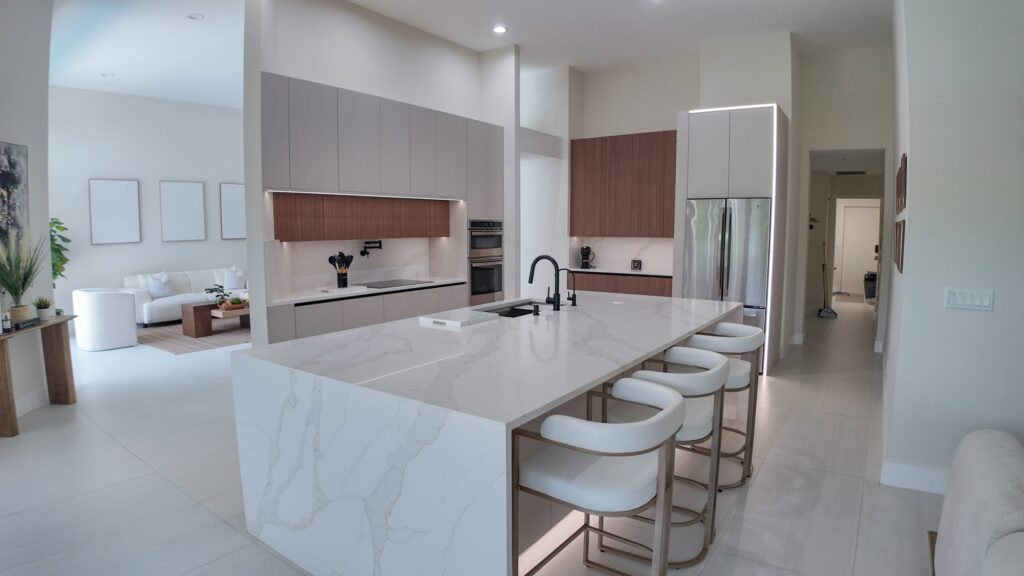
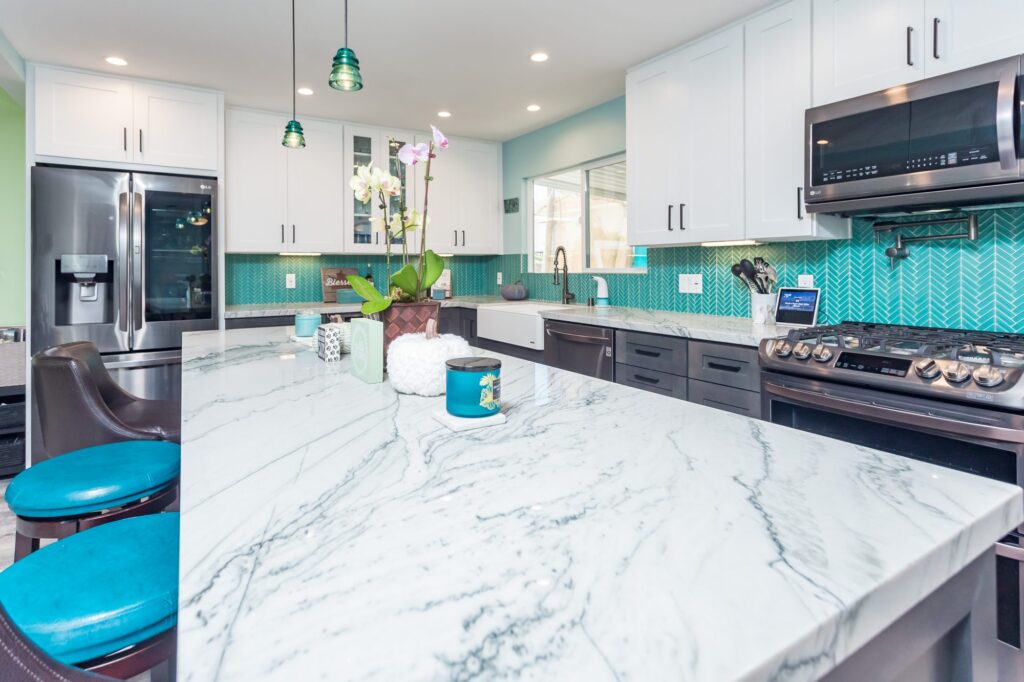
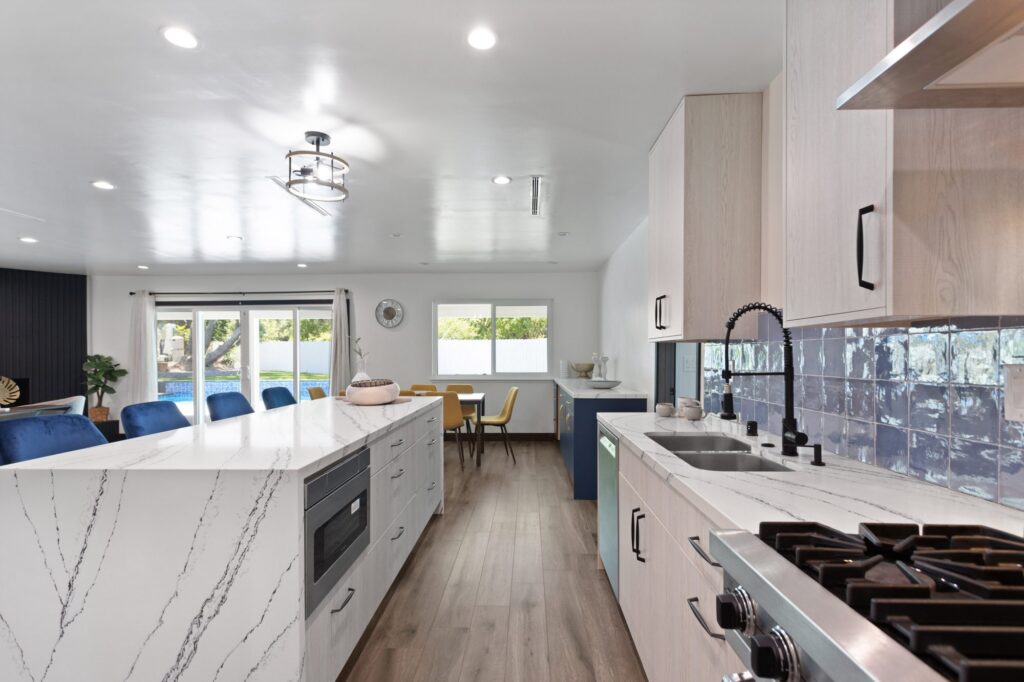
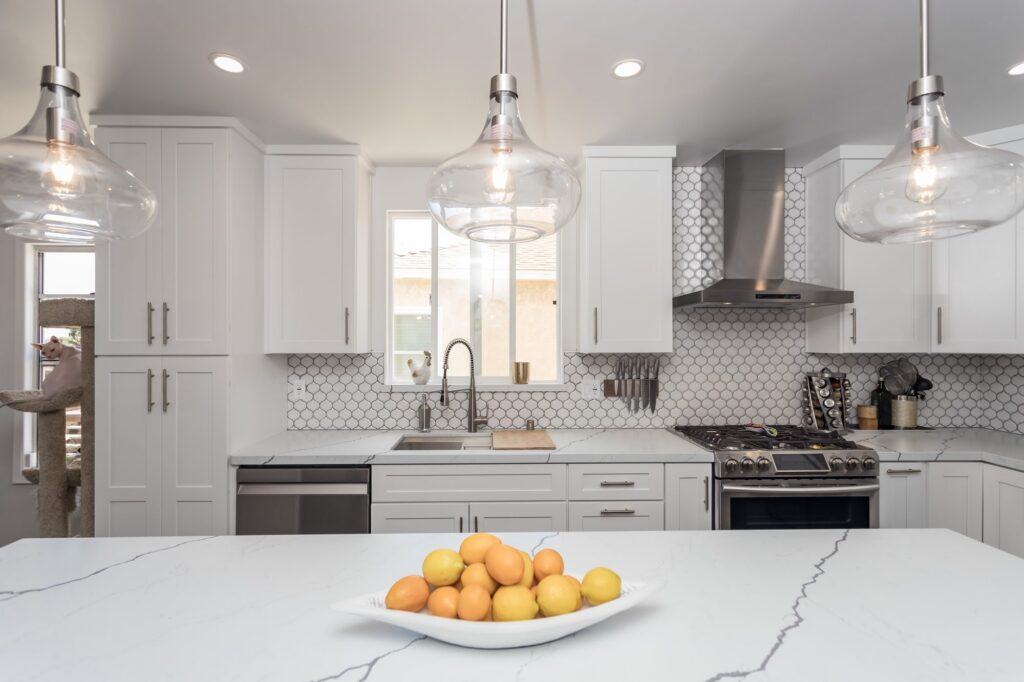
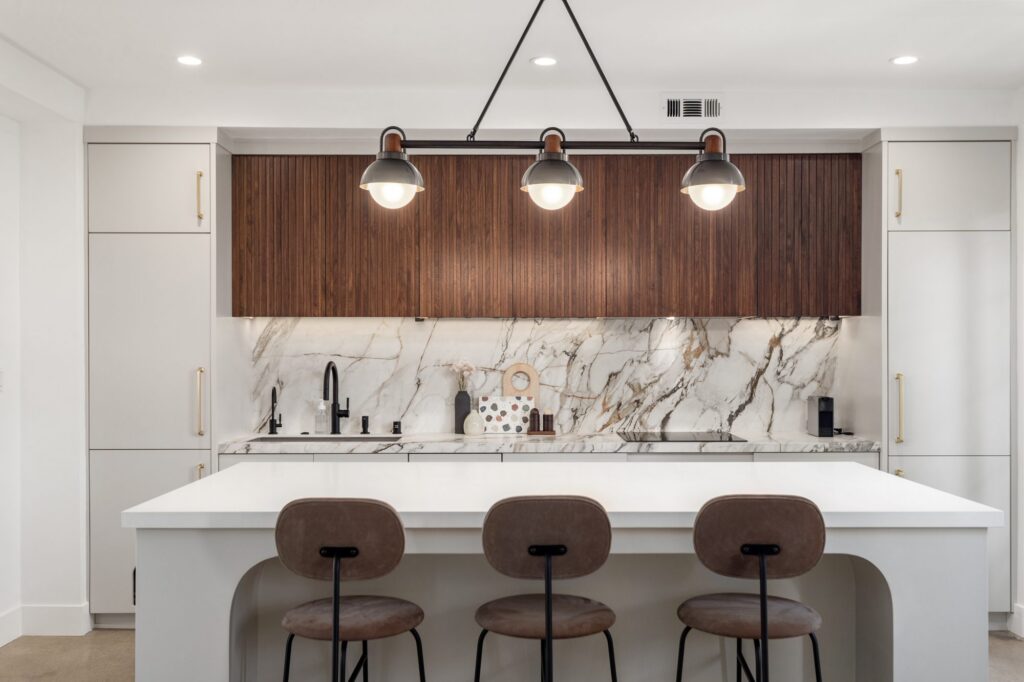
A waterfall-edge kitchen island with bar seating opening into the living room.A marble waterfall-edge island with teal bar stools and a stainless refrigerator.A waterfall-edge quartz island anchors this kitchen, with a gas cooktop and navy blue cabinetry beyond.A close-up of the kitchen island highlights the marbled quartz countertop, farmhouse-style sink, and view toward the stainless range.A kitchen island with wood tambour cabinetry, marble backsplash and a linear light fixture.
Walkthrough clip from a completed MAV kitchen. Close pan across the island countertop surface. (Silent clip, 15 s.)
From MAV’s video team
MAV promotional video: Reel: "The Materials Go on a Blind Date". Countertop, cabinet and lighting choices judged together rather than one at a time. Includes illustrative and concept scenes alongside project footage; has sound and captions.Read the transcript
The countertop looks great. The cabinet looks great. Together, they might need a conversation. Choosing finishes one at a time doesn’t always create a room that works together. Look at the combinations, the lighting, and the feel of the whole space. Let’s find a direction with some actual chemistry. Bring your ideas to MAV Design and Build.
Related kitchen guides
Kitchen Backsplash Guide: Slab vs Tile, Height & Grout
Sources checked October 25, 2026. Manufacturer and standards-body figures above are current published specifications as of that date and can change by product line — confirm with the fabricator before purchase.
I'm extremely satisfied with my kitchen renovation. The entire process was handled with professionalism and precision. The crew was respectful, efficient, and always made sure I was informed every step of the way. The final result — a beautiful, well-designed kitchen with top-quality finishes and excellent craftsmanship.
AviadApril 2026
★★★★★
Love their work, the kitchen turned out amazing and exceeded our expectations. Completed in much shorter time than I thought it would. Can't recommend them enough!!
Dwight HoldenMarch 2026
★★★★★
Great experience working with this company! They remodeled my kitchen and did an amazing job. The team was professional, easy to work with, and always on time. Everything went smoothly, and they paid attention to the small details.