

Porcelain tile, rigid-core luxury vinyl, and engineered or solid wood each handle water, traffic, and a Houston slab-on-grade differently. Here’s what the ANSI tile standard, manufacturer warranty language, wood-flooring guidelines, and FEMA’s flood-damage-resistant materials guidance actually say — so you can choose with the real tradeoffs in view, not marketing claims.
Book a Kitchen Remodel ConsultationCall (832) 532-6829Sources: ANSI A137.1 (via blog.ansi.org), NWFA Installation Guidelines, and FEMA Technical Bulletin 2 (checked Oct 25, 2026).
Is porcelain, luxury vinyl, or wood the best kitchen floor?
There’s no single best material — it depends on what you’re weighing. Porcelain tile is the most water- and scratch-resistant option, defined by ANSI A137.1 as having 0.5% or less water absorption. Rigid-core luxury vinyl offers a manufactured waterproof core at a typically lower installed cost than tile. Engineered or solid wood brings warmth and continuity with adjoining rooms but carries real moisture sensitivity, which matters more directly over a Houston slab-on-grade foundation.
Pick what matters most to you:
This helper summarizes general industry guidance, not a product recommendation or a determination for your specific home. Confirm product-specific requirements with the manufacturer and your contractor.
Porcelain and ceramic tile : the ANSI definition
Porcelain tile is a defined category, not a marketing term. Under ANSI A137.1, the American National Standard for ceramic tile (maintained by the Tile Council of North America), tile is classified by how much water it absorbs when tested:
+View as table
| Item | Value (% max absorption) |
|---|---|
| Impervious (porcelain qualifies here) | 0.5 |
| Vitreous | 3 |
| Semi-vitreous | 7 |
Source: ANSI A137.1:2022 ceramic tile water-absorption classification, via blog.ansi.org, cross-corroborated against an independent tile-industry technical explainer (novatileandstone.com). A fourth, open-ended “Non-vitreous” class (greater than 7.0%) exists but has no upper bound to chart. Checked Oct 25, 2026.
A tile only qualifies as porcelain if it tests at 0.5% absorption or less — a standard tested category, not just a glaze or look. That low absorption is why porcelain holds up well to spills, steam, and the occasional dropped pan, and why it is a common kitchen choice.
Rigid-core luxury vinyl : read the warranty, not just the box
SPC (stone polymer composite) and WPC (wood polymer composite) are the two common rigid-core luxury vinyl constructions, both widely marketed as waterproof. Read the specific product’s own warranty closely, though — even a manufacturer that covers spills and subfloor moisture still draws a boundary around what “waterproof” means. One major manufacturer’s warranty for its rigid-core line reads:
“…your Shaw product will not swell, cup, or crack due to: Normal cleaning practices… Moisture due to everyday household spills… Moisture from subfloor when exposed to such conditions. All sources of subfloor moisture should be remedied prior to installation. This warranty covers topical moisture as long as the water does not flow over the edge of the surface (edge of the room, cut boards, etc.)”
In plain terms: this particular warranty covers the plank material against everyday spills and even subfloor moisture — but it still expects subfloor moisture problems to be fixed before installation, not masked by the flooring, and its moisture coverage stops at water that “flows over the edge of the surface” (a flood or standing-water scenario, for example). The same document separately notes that mold or mildew can still develop in the subfloor even where the plank itself resists swelling, if excess moisture goes unaddressed. The same manufacturer’s installation guide sets a subfloor flatness requirement of 3/16″ in 10 feet, or 1/8″ in 6 feet — a different, and often more forgiving, tolerance than tile’s. Warranty terms vary by manufacturer and product line, so always read the specific product’s own documents rather than assuming this example applies (installation guide, checked Oct 25, 2026).
Engineered vs. solid hardwood : the moisture difference
Wood is dimensionally reactive to moisture by nature. Per the USDA Forest Products Laboratory’s Wood Handbook, wood swells as it gains moisture and shrinks as it loses it below the fiber-saturation point — the mechanism behind cupping, gapping, and warping in a wood floor that sees humidity swings.
Neither is waterproof. Both need spills wiped up promptly, and both perform best when the room’s humidity stays within the manufacturer’s stated range (NWFA Installation Guidelines; USDA Wood Handbook, Ch. 4, checked Oct 25, 2026).
Subfloor flatness : what each material actually requires
A floor that looks fine to the eye can still be out of the tolerance a specific flooring system requires. These are set by the installation standard or the manufacturer, not by guesswork:
| Material | Water exposure (what’s actually sourced) | Subfloor flatness (per install standard/guide) | Houston slab notes |
|---|---|---|---|
| Porcelain tile | ≤0.5% water absorption — ANSI A137.1’s Impervious class, the most water-resistant of the group. | ANSI A108.02: 1/4″ in 10 ft (standard tile); up to 1/8″ in 10 ft for large-format tile 15″ or larger (NTCA). | Works directly over a prepared, flat slab; have the installer confirm flatness before setting tile. |
| Rigid-core LVT (SPC/WPC) | Core material is manufactured waterproof; warranties set limits — read the product’s own warranty (see the example above). | Example (COREtec): 3/16″ in 10 ft, or 1/8″ in 6 ft — confirm with your product’s own install guide. | Floating click-lock systems are commonly installed directly over a slab once it meets the product’s flatness spec. |
| Engineered wood | More moisture-tolerant than solid wood due to its cross-layered core, but still a real wood wear layer. | Set by the manufacturer’s specified method (glue-down, nail-down, or floating) — tolerances vary by method. | Often the more cautious choice directly over a slab; ask the manufacturer about slab-specific requirements. |
| Solid hardwood | The most moisture-sensitive of the four — NWFA recommends 30–50% job-site relative humidity. | Set by the manufacturer/installer; NWFA guidelines apply by installation method. | Generally the least common choice directly over a slab without an engineered subfloor system. |
Flooring before or after cabinets ? real tradeoffs, not a rule
- 1BenefitContinuous look under the toe-kickThe finish floor runs under the cabinets, which simplifies a future layout change since the floor doesn’t need patching where cabinets once stood.
- 2TradeoffMore material, more protection neededYou pay for flooring under the full footprint, including space the cabinets will cover, and the finished floor has to be protected through the rest of the remodel.
- 1BenefitLess material, less exposure to damageFlooring only covers the visible area, and it goes in closer to the end of the project, with less risk of scratches or dents from other trades.
- 2TradeoffA gap under the toe-kick to plan forA future layout change that moves or removes cabinets can leave a patch of subfloor that needs to be matched or covered.
Both sequences are used routinely; which one fits depends on your layout, your flooring material, and whether a future layout change is a real possibility. Ask your contractor which order they recommend for your specific kitchen.
Testing a Houston slab before the new floor goes down
Most Houston kitchens sit on a concrete slab-on-grade, and some flooring systems and adhesives set a maximum allowable slab-moisture reading before installation. Two ASTM test methods are the industry-standard ways to measure it:
Which test (or both) applies, and what reading is acceptable, is set by the specific flooring manufacturer and adhesive system — there isn’t one universal number across every product, so this is a question to raise with your contractor and the flooring manufacturer before installation, not something to assume (ASTM F2170, ASTM F1869, checked Oct 25, 2026).
Flood-damage-resistant material classes : the concept, in brief
Houston’s flood risk makes this worth understanding, even outside a mapped flood zone. FEMA’s Technical Bulletin 2 sorts building materials — including flooring — into five classes by how well they tolerate water exposure. In the bulletin’s own words:
“5 — Highly resistant to floodwater damage. Materials within this class are permitted for partially enclosed or outside uses with essentially unmitigated flood exposure.”
“4 — Resistant to floodwater damage. Materials within this class may be exposed to and/or submerged in floodwaters in interior spaces and do not require special waterproofing protection.”
FEMA’s bulletin states that “only Class 4 and Class 5 materials are acceptable for areas below the BFE in floodprone buildings,” though it adds that Class 1, 2, and 3 materials “may be permitted below the BFE, when specifically required to meet local building code provisions concerning life-safety issues.” The same bulletin lists two reasons flooring often lands in the lower classes: materials that “contain wood and wood products,” and sheet-type coverings like vinyl that “restrict evaporation from below.” This is general background on FEMA’s own classification system, not a statement about any specific home’s flood zone, elevation, or which class a particular flooring product is rated at — that depends on the product and your property’s own flood-zone status. If flood exposure is a real concern for your address, ask your contractor and check with the City of Houston floodplain office or a licensed surveyor before choosing a material (FEMA Technical Bulletin 2, checked Oct 25, 2026).
Kids, pets, and what’s easiest to clean
Completed MAV kitchen project; location not published.
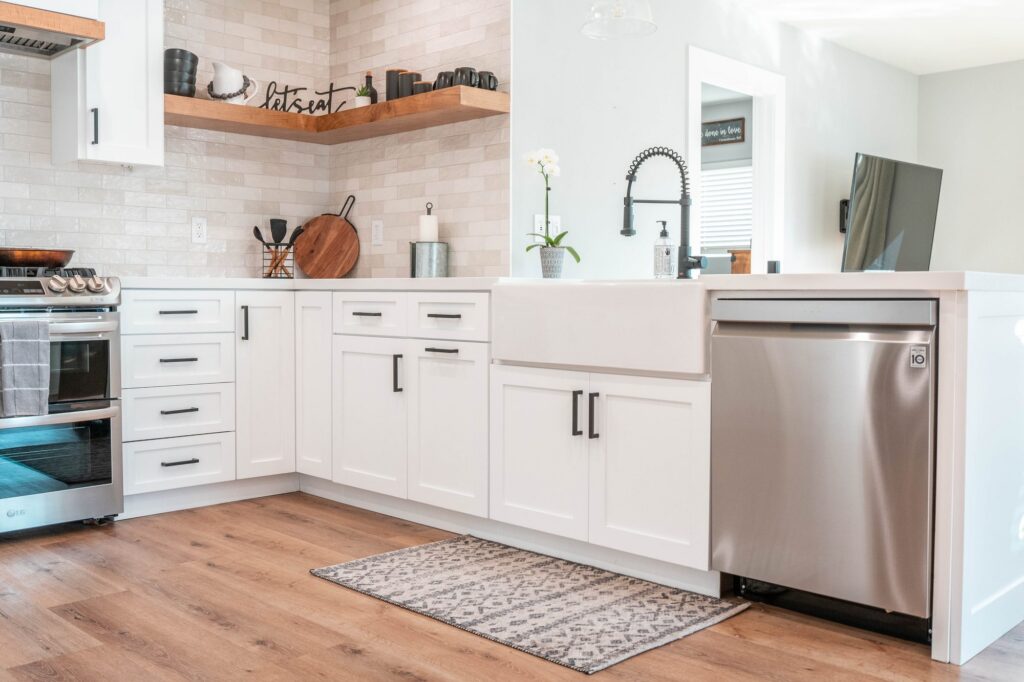
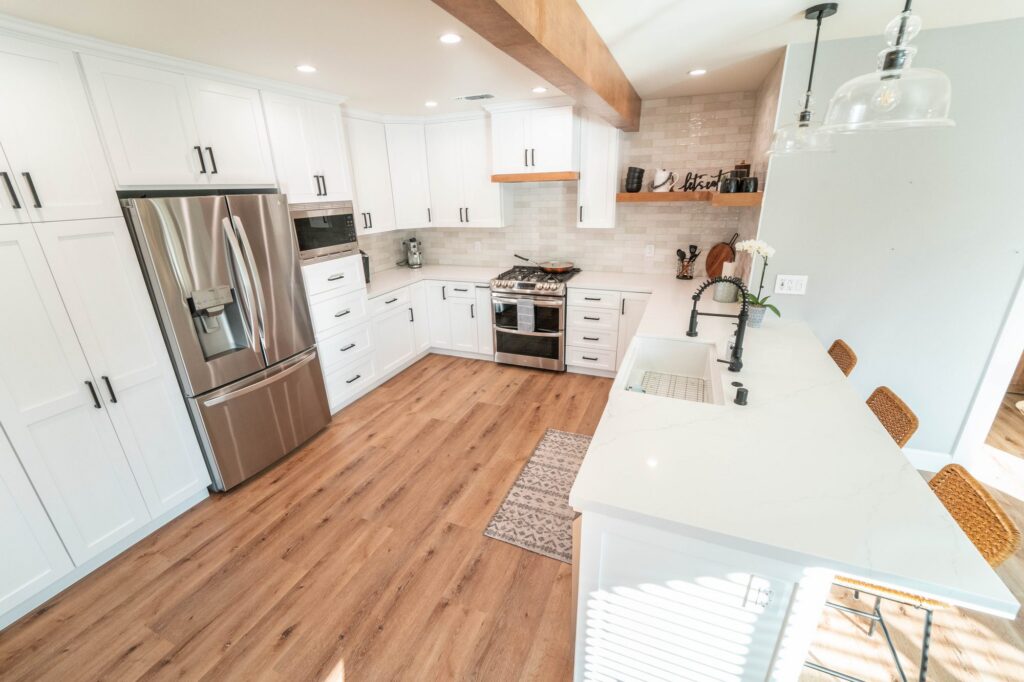
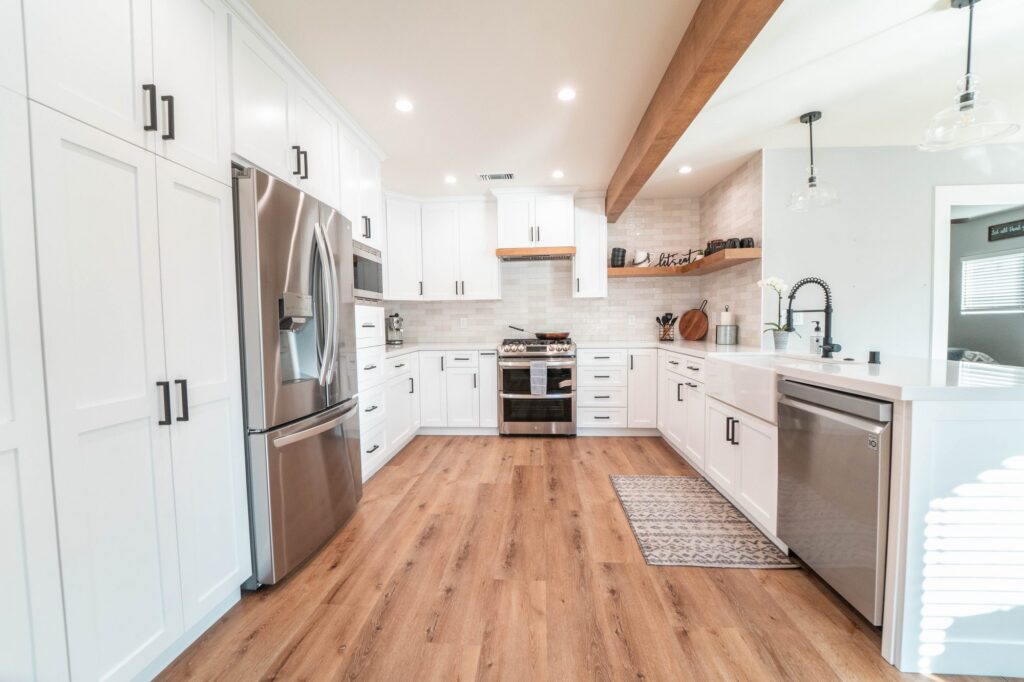
Completed MAV kitchen project; location not published.
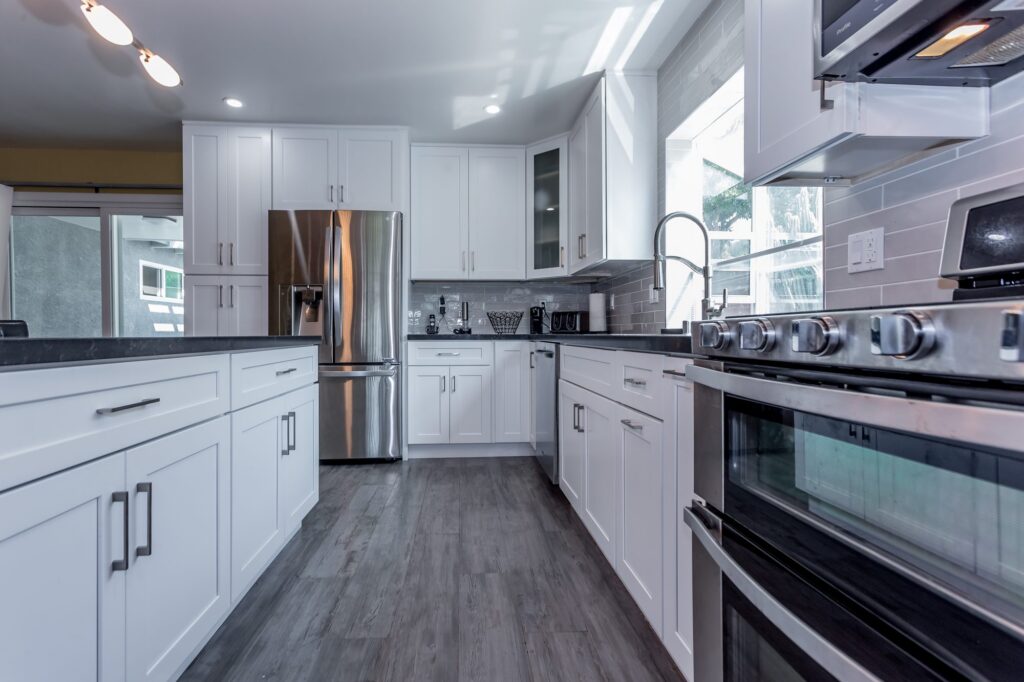
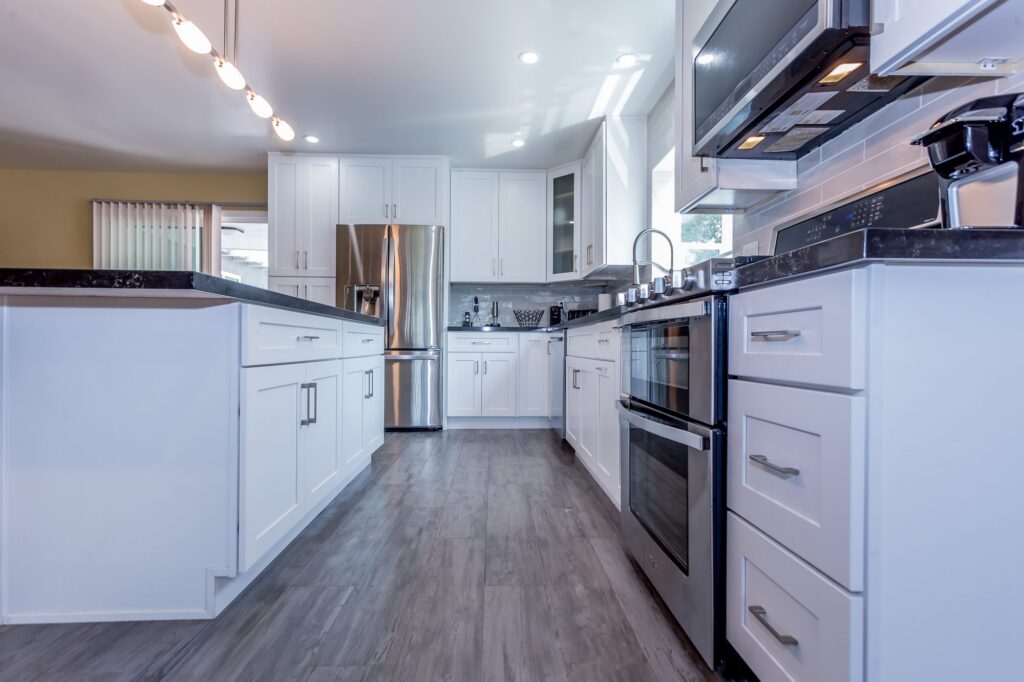
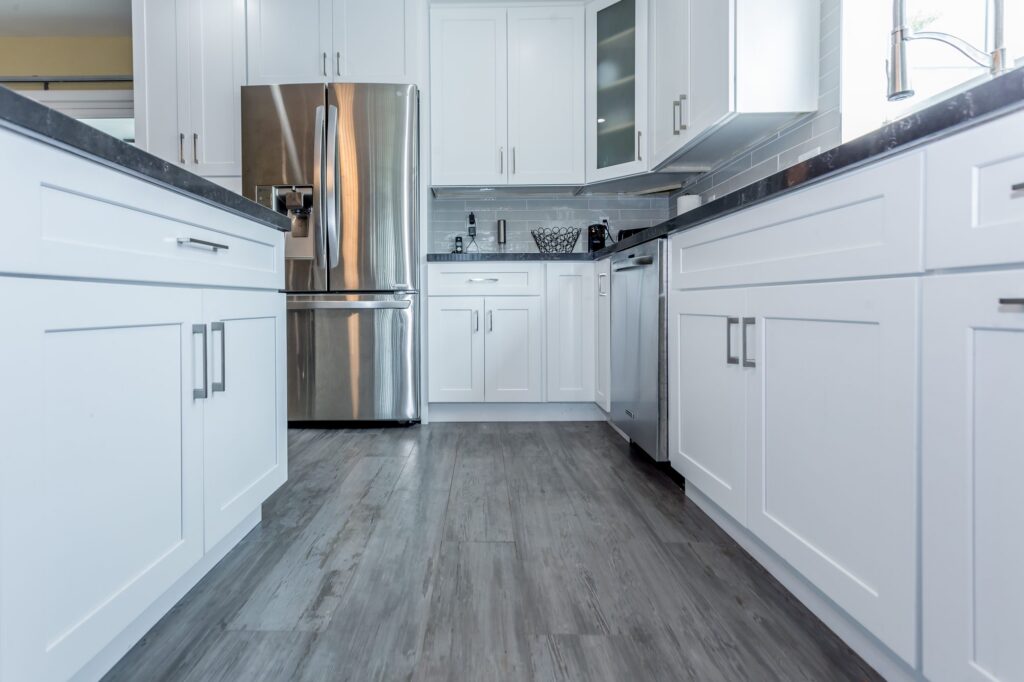
Verified Google reviews from MAV Design & Build kitchen remodeling clients.
“We had a great experience with our kitchen renovation. The crew was easy to work with, very responsive, and kept everything clean and organized throughout the project.”
“Really nice kitchen upgrade. The work was done on time and looks amazing.”
“Love my new kitchen! Smooth process, good communication, and the final result speaks for itself.”
About MAV Design & Build
Frequently asked questions
Can I keep my existing kitchen flooring during a remodel?+
Should flooring go in before or after new cabinets?+
What flooring is best for a kitchen?+
Is luxury vinyl suitable for a kitchen?+
Is porcelain tile better than hardwood in a kitchen?+
Should kitchen flooring match the living room?+
What kitchen flooring is easiest to clean?+
What flooring is best for kids and pets?+
Planning a kitchen remodel?
A kitchen remodel means choosing cabinets, countertops, layout — and flooring. Talk through the options before you commit to a material.
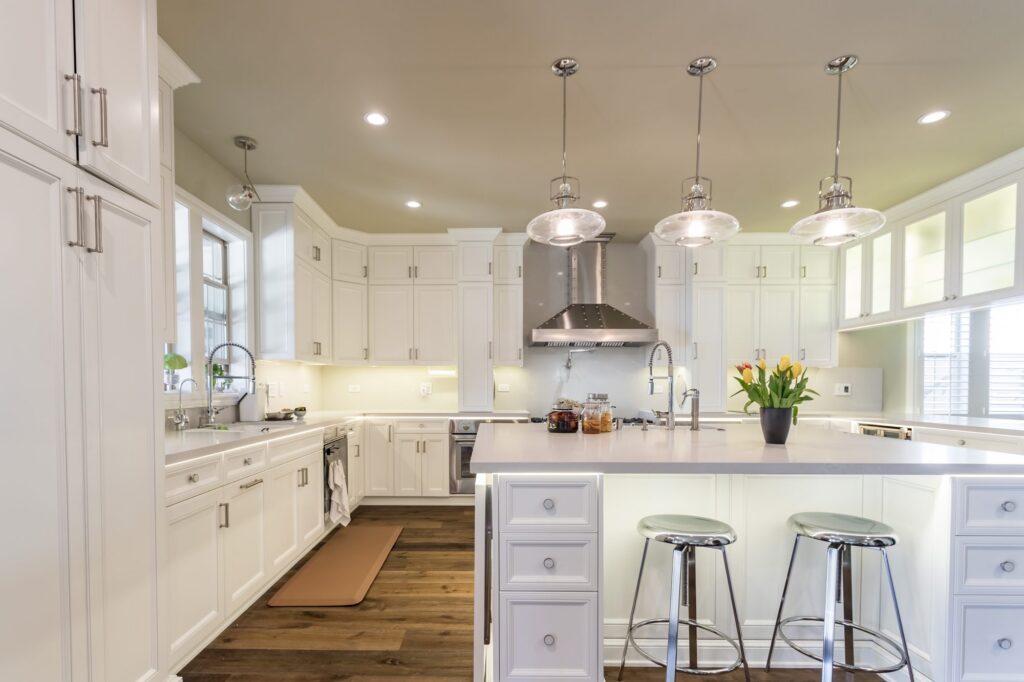
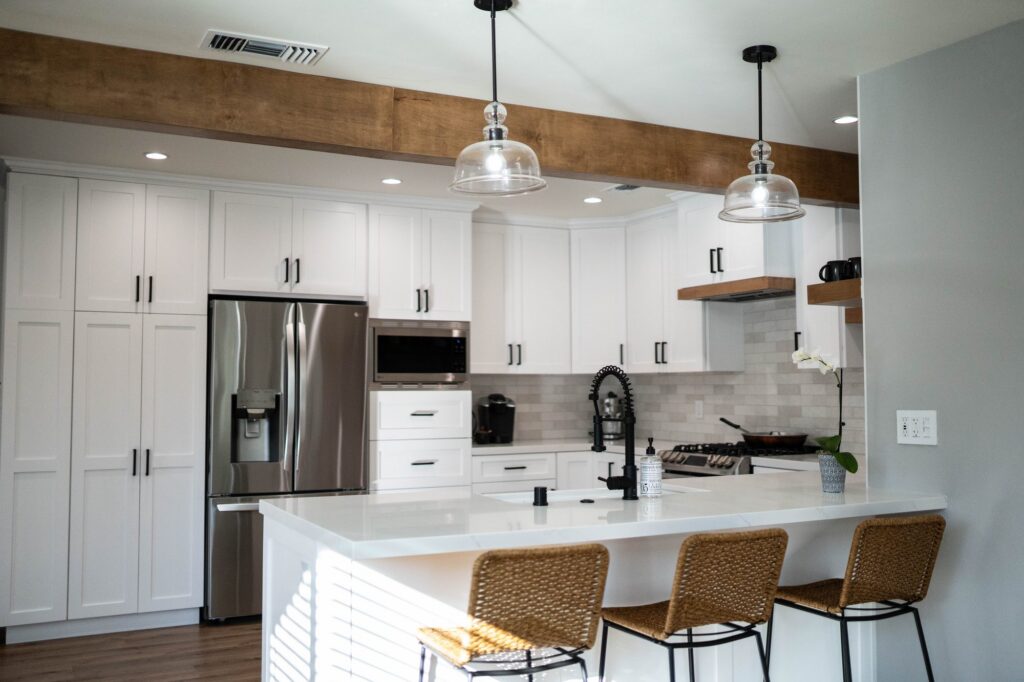
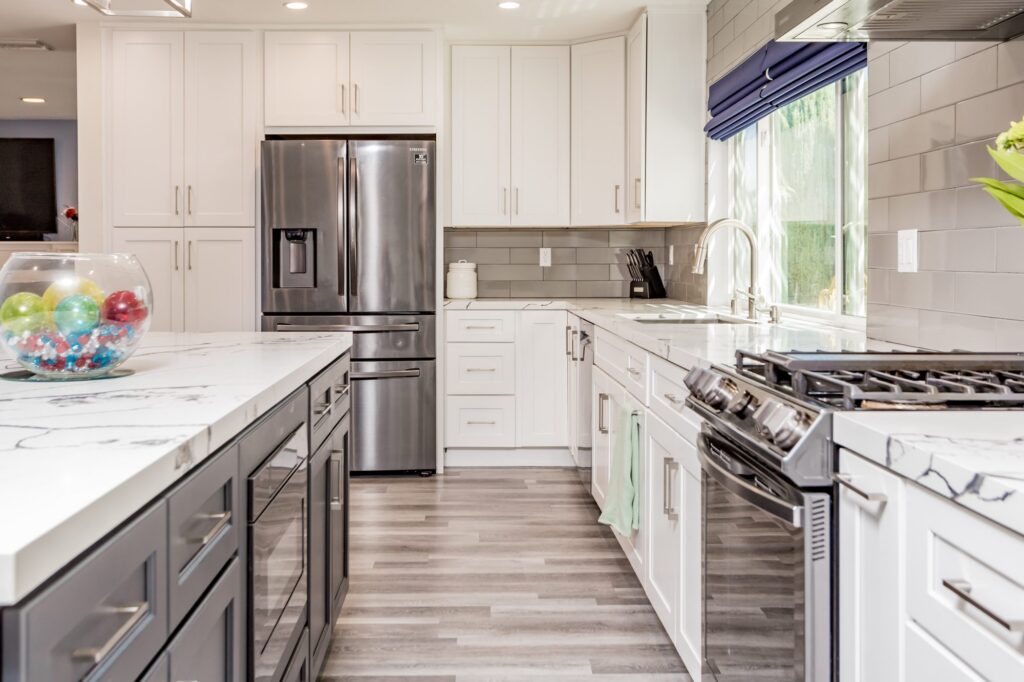
Book a Kitchen Remodel ConsultationCall (832) 532-6829Kitchen floors as installed
Flooring under cabinets and islands in completed projects. Locations are not published.
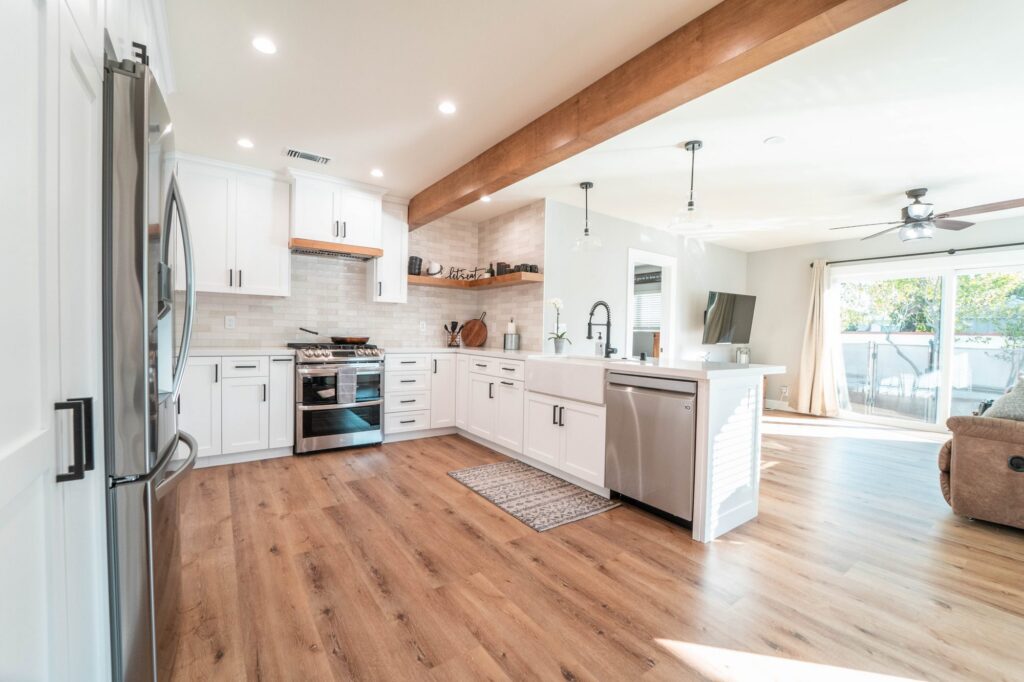
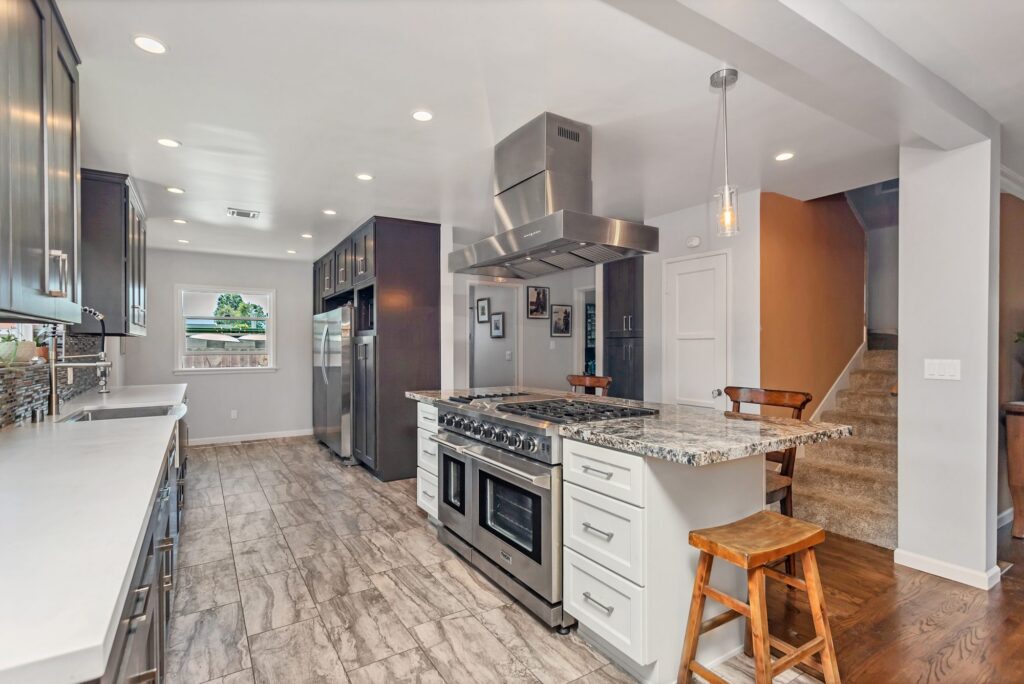
From MAV’s video team
Read the transcript
Houston, Texas homeowners. The difference between an average kitchen and a luxury kitchen is planning. With MAV Design and Build, your kitchen remodel starts with a full design strategy before construction ever begins. We help homeowners optimize layout, improve flow, maximize storage, and select finishes that create a premium look and feel. From custom cabinetry to lighting and materials, every detail is planned intentionally. The result is a kitchen that functions better, feels more expensive, and increases the value of your home. Plus, receive up to $5,000 credit toward your project. Click below to secure your kitchen consultation today.
Related kitchen guides
Read the guide →
Read the guide →
Read the guide →
Browse every guide in MAV’s kitchen remodeling guide library.
This flooring guide is one part of planning a kitchen remodel. See what’s typically included in a kitchen remodel, current kitchen design trends, the step-by-step Houston kitchen remodel process, and MAV’s own kitchen remodel cost guide. For the full service overview, see kitchen remodeling, or browse the full kitchen remodeling guide library.
- ANSI A137.1:2022 ceramic tile water-absorption classification (porcelain = Impervious, ≤0.5%)
- ANSI A137.1 water-absorption classes — independent tile-industry technical explainer
- COREtec Plus Comprehensive Residential Warranty (Shaw Industries) — water-damage exclusions
- COREtec Advanced Installation Instructions — subfloor flatness requirement
- National Wood Flooring Association (NWFA) Installation Guidelines — job-site relative humidity, moisture content
- USDA Forest Products Laboratory, Wood Handbook, Chapter 4 — Moisture Relations and Physical Properties of Wood
- National Tile Contractors Association / ANSI A108.02 — subfloor flatness tolerance for tile
- ASTM F2170 — Standard Test Method for Determining Relative Humidity in Concrete Floor Slabs Using In Situ Probes
- ASTM F1869 — Standard Test Method for Measuring Moisture Vapor Emission Rate of Concrete Subfloor Using Anhydrous Calcium Chloride
- FEMA Technical Bulletin 2 — Flood Damage-Resistant Materials Requirements (rev. 01-22-2025)
Sources checked October 25, 2026.
Planning a kitchen remodel in Clear Lake, TX? See MAV’s Clear Lake kitchen remodeling guide for local pricing and process details.
I'm extremely satisfied with my kitchen renovation. The entire process was handled with professionalism and precision. The crew was respectful, efficient, and always made sure I was informed every step of the way. The final result — a beautiful, well-designed kitchen with top-quality finishes and excellent craftsmanship.
Love their work, the kitchen turned out amazing and exceeded our expectations. Completed in much shorter time than I thought it would. Can't recommend them enough!!
Great experience working with this company! They remodeled my kitchen and did an amazing job. The team was professional, easy to work with, and always on time. Everything went smoothly, and they paid attention to the small details.